Srinagar to Leh bike rental
There’s a particular kind of excitement that comes with picking up your bike rental in Srinagar, helmet in hand, knowing that roughly 434 kilometres of the Srinagar-Leh highway are waiting just past the city limits. There’s also a particular kind of confusion that shows up right before it. Every website seems to say something different. One tells you an Inner Line Permit is compulsory. Another says permits were scrapped years ago. A third claims your rented bike can go anywhere in Ladakh, and a fourth insists it can’t leave Leh at all.
Here’s the honest answer: the rules really have changed, and most of what’s online hasn’t caught up. 2026 alone has brought a historic winter opening at Zoji La, a major tunnel breakthrough, and a permit system that barely resembles the one from just a few years ago.
This guide clears up the confusion. By the time you finish reading, you’ll know exactly which documents to carry, which stretches actually need a permit, and how to plan the ride whether you’re travelling solo, as a couple, with family, or chasing pure adventure on two wheels.
Quick answer: The Srinagar-Leh highway runs about 434 km and takes two unhurried days to ride, with an overnight stop in Kargil. In 2026, no permit is needed for the highway itself — you’ll only need the online Ladakh Environment Fee if you continue past Leh into Nubra, Pangong, or Tso Moriri. And remember: a bike rented in Srinagar can only take you as far as Leh, not beyond it
Why 2026 Is a Turning Point for the Srinagar-Leh Ride
If you rode this highway a few years ago, forget most of what you remember. 2026 has genuinely been a landmark year for this route. In March, the Border Roads Organisation kept Zoji La Pass open right through the winter for the very first time in its history. This is a pass that has shut down every single year for as long as most riders can recall.
Then, in June, engineers achieved the excavation breakthrough on the Zojila Tunnel: a 13.15-kilometre bore that will eventually cut crossing time from over three hours to about 15 minutes. Full operations are targeted for 2028. For now, the legendary hairpin climb over Zoji La, narrow and guardrail-free, is still exactly as riders have always known it.
Closer to Srinagar, the Z-Morh Tunnel near Sonamarg has been open since January 2025, keeping that stretch accessible even in the depths of winter.
What does this mean for you? The riding season is stretching longer than it used to. But the mountains still set the final schedule. A late-season snowfall can shut the pass for a day or two even now, so treat any live road-status update as more reliable than a blog post, including this one.
The Route at a Glance: 434 Kilometres From Srinagar to Leh
The classic Srinagar-Leh highway, officially NH1, covers about 434 kilometres. Most riders take two unhurried days, with an overnight halt in Kargil. If altitude is a concern, three days is kinder on your body.
Here’s the shape of the ride:
Srinagar to Sonamarg (~80 km): A gentle warm-up through Ganderbal and Kangan, with pine forests closing in as the valley narrows.
Sonamarg to Kargil (~140 km): The big one. This stretch climbs over Zoji La (3,528 m), passes through Drass, the second-coldest inhabited place on Earth, and ends in Kargil for the night.
Kargil to Leh (~215 km): The passes give way to open, lunar-looking high desert. You’ll cross Namika La and Fotu La (4,108 m, the highest point on this entire route), then roll through Lamayuru, whose eroded moonscape hills make it one of the most offbeat, photogenic stops on the highway, before Khalsi, Nimmu, and finally Leh.
Splitting that middle stretch across three days instead of two simply means you’re not pushing from near sea-level Srinagar to 3,500-metre Leh in 48 hours. Your body, and your bike, will thank you for the extra time.
Timing It Right: The Best Months to Ride in 2026
June through September remains the sweet spot. Both major passes stay reliably open, the weather holds steady, and long daylight hours mean you get to enjoy the ride instead of racing it.
The Srinagar side typically opens earlier than the Manali route, often by April and occasionally even March in a mild year, since Zoji La sits lower than the passes on the Himachal side. That said, “open” in April or May can still mean fresh snow, temporary closures, and single-lane convoy traffic at Zoji La, with vehicles let through in one direction at a time, commonly mornings from Sonamarg towards Drass and evenings the other way.
Miss that window, and you could be waiting hours for the next one. Riding in the shoulder months? Build in a spare day or two. Start every leg at first light, and check the current road bulletin the morning you leave, not the night before.
Come October, temperatures drop fast, and the comfortable riding window starts closing. The highway typically shuts for winter sometime in November or December, depending on that year’s snowfall.
Permits and Paperwork: What You Actually Need in 2026
This is the part where blog posts contradict each other most, so here’s the clear, current picture.
| Indian nationals | Foreign nationals | |
|---|---|---|
| Highway itself & Leh town | No permit needed | No permit needed |
| Nubra, Pangong, Tso Moriri, Hanle | Ladakh Environment Fee (~ ₹ 550 590) | Protected Area Permit via a registered agent |
| Extra ID to carry | Aadhaar or passport | Passport, visa, International Driving Permit |
Indian Nationals: No More Inner Line Permit
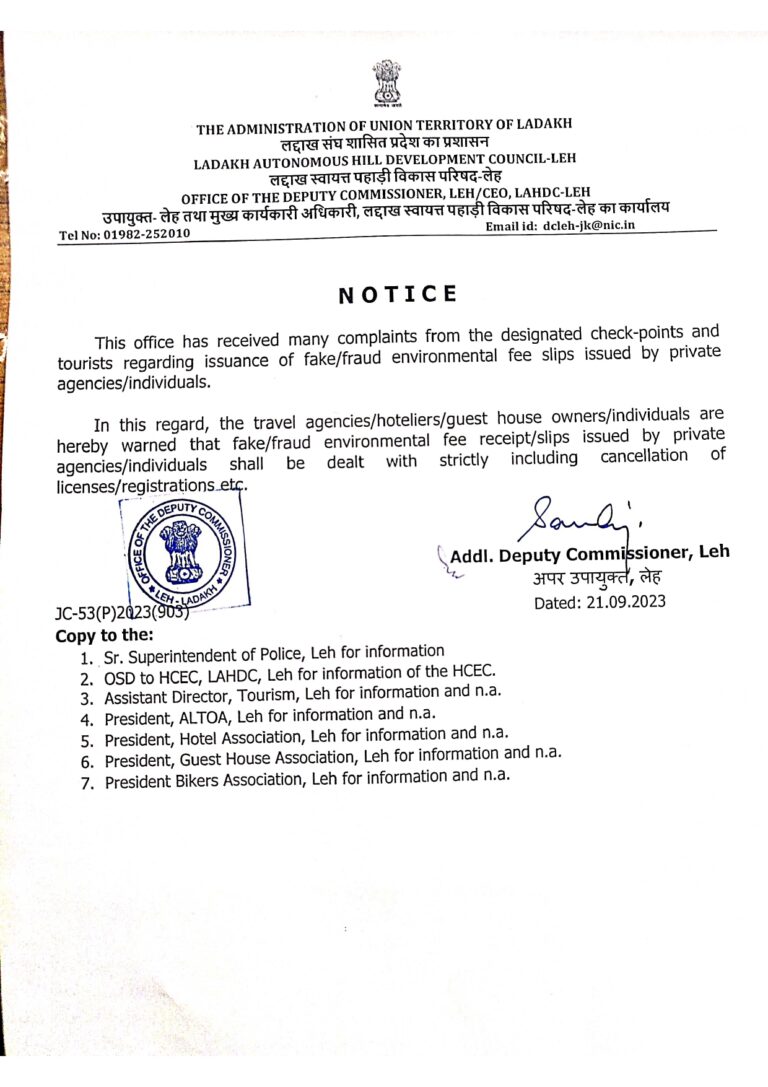
The old-style Inner Line Permit was phased out back in 2021. In its place is the Ladakh Environment and Development Fee, paid online through the official LAHDC Leh permit portal (lahdclehpermit.in). Here’s the good news first: you don’t need this fee, or any permit, for the Srinagar-Leh highway itself or for Leh town. It only applies once you continue into restricted circuits beyond Leh, such as Nubra Valley, Pangong Tso, Tso Moriri, Hanle, Umling La, Khardung La, and Chang La.
The fee structure is refreshingly simple: roughly ₹ 400 as a one-time environment fee, ₹ 20 per day as a wildlife protection charge, and an optional ₹ 50 towards the Red Cross fund. For a typical five- to seven-day circuit, expect to pay somewhere around ₹ 550–590 per person.
Register online, select every area you might possibly visit (adding extra ones costs nothing), and pay by card or net banking. Then print at least five to eight copies of your receipt. You’ll hand one over at every checkpost, including South Pullu, Karu, and Khardung La.
Foreign Nationals: The Protected Area Permit Still Applies
Travelling on a foreign passport changes things. You’ll need a Protected Area Permit for the same restricted circuits, and while an “overseas registration” option exists online, payment gateways are notoriously unreliable for foreign cards. Working with a registered Leh travel agent is still the smoother route.
Carry your passport, visa, and an International Driving Permit. It’s mandatory for foreign riders and does get checked at highway posts. A handful of nationalities and passport categories, including diplomatic and journalist passports, face extra clearance steps, and some circuits have historically asked for a minimum of two travellers rather than one solo foreign rider. These specifics shift occasionally, so confirm with your agent close to your travel dates rather than trusting last year’s blog post.
The One Rule Most Riders Miss: Where a Srinagar-Rented Bike Can (and Can't) Go
Here’s something that catches even experienced riders off guard: a bike rented in Srinagar is valid only to get you to Leh. It cannot legally be used for sightseeing beyond that. No Nubra Valley, no Pangong Tso, no Khardung La, no Tso Moriri.
Once you reach Leh, if you want to continue into those inner-line circuits, you have two options. Rent a second bike that’s locally registered in Leh, or ride one registered in your own name, or an immediate family member’s, with proof of the relationship.
This rule applies no matter which city you rented from, whether that’s Srinagar, Manali, or Delhi, and it’s enforced right at the checkpoints. It’s worth planning around rather than discovering the hard way, halfway up Khardung La.
For most riders, this actually works out well. You get the iconic Kashmir-to-Ladakh crossing on a bike you’ve already grown comfortable with, then switch to a well-maintained, altitude-tested local bike for the more remote circuits, where mechanics and spares are much harder to come by.
Fuel, Food, and Fixing a Flat: Practical Stops Along the Way
Range anxiety isn’t really a thing on this route. The Srinagar-Leh highway is one of the better-served roads in the Himalayas for fuel.
You’ll find pumps at Ganderbal, Kangan, Sonamarg (Gagangir), Drass (small, occasionally out of stock), and Kargil, which is your last reliable, high-volume fill-up before Leh. From there, Mulbekh, Lamayuru, and Khalsi all have stations too, spaced roughly 90–125 kilometres apart. A good rule of thumb: top off fully at Kargil, and again at Khalsi if your tank is on the smaller side.
Mechanics are easiest to find in Ganderbal, Sonamarg, Drass, and Kargil for anything minor, like a chain adjustment, a puncture, or a loose cable. Save bigger repairs for before you leave Srinagar or once you reach Leh, since spare parts thin out the further you get from either end.
Most small towns along the way, including Kangan, Gund, Baltal, and Mulbekh, have basic puncture-repair stalls. A flat tyre here is an inconvenience, not a crisis.
Riding Solo, as a Couple, With Family, or Chasing Adventure
Every rider on this highway has different priorities. Here’s what actually matters for each.
Solo Travellers
You’re in good company. This is one of India’s most popular solo rides. Share your day-by-day plan with someone back home, and save the contact for the nearest army checkpost or medical post for each leg. Riding solo also means you set the pace entirely, so slow down for Drass’s war memorial or an extra chai stop without checking with anyone.
Couples
For couples, the two-day version can feel rushed. Stretch it to three days and add an evening in Kargil or an extra night in Sonamarg, so you’re enjoying each other’s company and not just the road. Pack an extra layer specifically for your pillion rider; they get cold faster than whoever’s on the handlebars.
Families
Travelling with family often means mixing vehicles: one experienced rider on the bike, the rest in a car or taxi, meeting at each overnight stop. If children or older relatives are along, three to four days minimum is worth the extra cost, since altitude affects everyone differently, and rushing is usually where the discomfort starts.
Adventure Riders
Chasing the adventure of it? Zoji La in its current, un-tunnelled form is the highlight, so ride it while it’s still the real thing. Beyond Leh, remember the rental rule from earlier: swap into a Leh-registered bike for Khardung La, Pangong, or Nubra. And don’t skip the offbeat Lamayuru-to-Alchi stretch, which sees far fewer riders than the main highway despite running right alongside it.
Staying Safe: Altitude, Weather, and the Zoji La Stretch
Leh sits at roughly 3,500 metres, and altitude sickness doesn’t care how fit you are. Spending your first night in Kargil, at around 2,700 metres, is already a good acclimatisation step.
Drink more water than feels necessary, skip the alcohol for your first 24 hours in Leh, and treat any persistent headache, nausea, or dizziness as your body asking for a rest day before you go any higher.
On the road itself, Zoji La demands respect rather than fear. Narrow sections, blind curves, and drops without guardrails mean slow, steady riding beats speed every single time. Give way to army convoys and loaded trucks, since they have far less room to manoeuvre than you do, and avoid riding after dark, when visibility on unlit mountain roads drops fast.
Finally, check a live road-status source, whether that’s BRO’s updates or a local operator who rides the route regularly, on the actual morning you leave. Weather at 11,000 feet changes faster than any blog can keep up with.
Choosing the Right Bike (and Rental Partner) in Srinagar
For this specific route, your bike choice matters more than brand loyalty.
A Kashmir bike rental built for this specific route needs three things in place before you ever leave Srinagar: current RC and insurance, a valid PUC certificate, and clear written terms on damage and late return, alongside helmets for both rider and pillion.
This is exactly the gap a local, experienced operator fills. Kashmir Travelogue, a Srinagar-based rental service running since 2016 and an authorised Royal Enfield rental partner, is built around this specific route. Its bike rentals in Srinagar, Kashmir, come with documentation support, permit guidance, and 24/7 assistance, at rates that stay competitive whether you’re picking a Classic 350 or a Himalayan.
Whether you’re comparing bike rental Srinagar options for the first time or simply typing “bike rent in Srinagar” into Google, ask three questions before you sign anything: is the paperwork current, is the bike serviced for altitude and rough roads, and is there someone to call if something goes wrong 300 kilometres from the nearest big city?
The Ride Is Yours to Plan
The Srinagar-Leh highway hasn’t lost any of its magic. If anything, 2026 has made it more interesting, not less. You’re riding through a genuine moment of change: the last few years of the raw Zoji La crossing before a tunnel reshapes it for good, alongside a permit system that’s finally simple enough to actually enjoy planning around.
Sort your paperwork, pick the bike that matches your route and your riding style, and give the altitude the respect it deserves. Do that, and the only real decision left is which offbeat stop you’ll linger at a little longer than planned: Drass at sunrise, Lamayuru’s moonscape, or the still, cold quiet of Sonamarg before the crowds arrive.
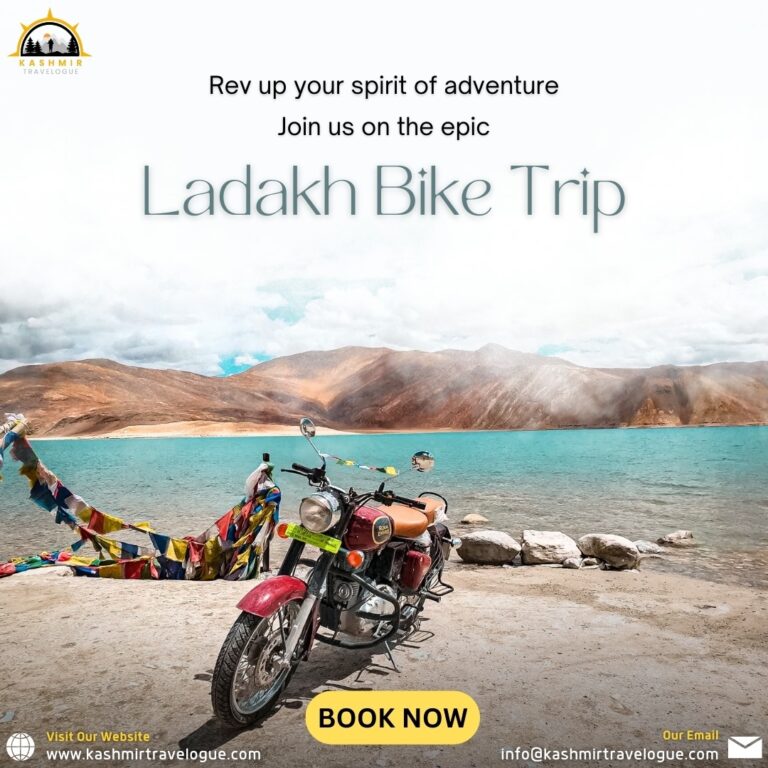
Book Your Ladakh Bike Trip
FAQ'S about Bike Rental From Srinagar to Leh
No. The highway itself, and Leh town, need no permit or fee for Indian nationals. Permits, now structured as an environment fee, only apply if you continue into restricted areas like Nubra Valley or Pangong Tso.
No. Bikes rented outside Ladakh can only be used to reach Leh, not for sightseeing in Nubra, Pangong, Tso Moriri, or Khardung La. You'll need a Leh-registered rental, or your own bike, for those.
Two days is the standard pace, with an overnight in Kargil. Three to four days is easier on your body, especially if you're travelling with family or aren't used to altitude.
June through September, when both major passes are reliably open and the weather is at its most stable.
Shoulder months, April–May and October, are possible but need flexible planning.
Yes. Foreign nationals need a Protected Area Permit for restricted circuits, best arranged through a registered Leh agent, along with an International Driving Permit for riding anywhere in India.
It's generally considered gentler than the Manali-Leh highway: one major pass instead of five, a more gradual altitude gain, and more towns along the way for fuel, food, or help. Zoji La itself still demands a calm, experienced hand, so build confidence on shorter mountain rides first if this is your first big trip.
Instagram: https://www.instagram.com/kashmir_travelogue/